Pages

Tuesday, July 28, 2015

Tilt-Shifty

Faux Tilt-shift project
Big Sur Tilt-shift

Tilt-shift camera lenses are a rarefied accessory used for very specialized applications. Essentially, they involve manipulating the depth of field visible in the image by changing the relative relationship between focal planes...I'll humbly admit I don't fully grasp the optical principles involved.

This is fun. We're having fun.

Tilt-shift has traditionally been used in landscape and building photography to counter issues of perspective. However, it's most well know these days for miniature-faking; making real world pictures look like they've been taken of a miniature world. Which apparently is a thing some people are really in to. You can see some great examples here.

So a picture of a busy street with tilt-shift-ery creates an optical illusion, making it seem like a shoe box diorama of miniatures. The optical illusion has something to do with very shallow depth of field, and the way our mind interprets distance by changes in depth of field. or something.  I've never messed with it much, given a lack of an expensive tilt-shift lens or, honestly, any interest whatsoever.

That being said, a friend linked me to a website that creates a faux tilt-shift effect on your photos. As part of a personal goal to do more photography projects this year, I gave it a whirl with some pics from my archive. As it turns out, it's not as easy as it looks. To really fool the eye, you need to have some very specific circumstances. You have to have a area of similar distance that's parrallel to the focal plane, and you need surroundings that aren't an immediate tip-off...like a background of sea and clouds, which are cues to the brain of context. The best of this type of picture are often streetscapes taken from wider angles. Some of mine turned out ok, but most failed the test.


This shot of Heimay Harbor in the Vestmannaeyjar Islands worked pretty well because it's far enough away, taken form slightly above, and the isolated area of focus is all roughly the same real world distance away. 

This picture of historic buildings at Thingvellir, Iceland works to some degree, but the eye notices the mountains in the background. A cropped version might work better. 

From Cannery Row, in Monterey, this picture would have worked better if there were some cars in the same focal area as the crossbridge. Because the focus is horizontal, but the picture has depth that moves vertically/into the picture, focusing on the road doesn't work well. 

Yet another Iceland image, this line of icebergs made a really good parallel area of focus.

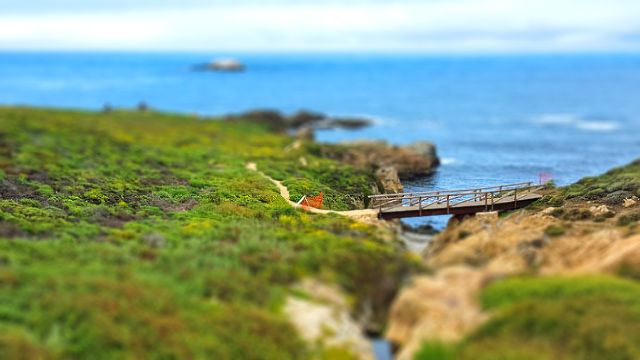
This bridge from Big Sur, California would have worked better of the sky had been cropped out.

A tiny toy car? No, full-sized Lotus in Besalu, Spain. So-so on this one. The picture is too tightly framed to really create an illusion. 

Another shot from Spain (boats at Cadaques). Another opportunity to improve a good horizontal focus area by cropping out context clues like the sky and clouds behind. However, the area behind the boats is so deep to begin with, our eye is not fooled very much. It looks like just a very shallow depth of field picture. 

This is another take on the Cadaques "toy" boats. 

While we're on boats...this shot of "toy" ships in a Washington harbor might have worked better in color. 

This arch in Central Park seems to work well, even though the light is partially in focus, and partially (at its base) out. Going in later and blurring the area through the arch would probably accent the effect. If I was overly motivated. 

This Bridge in Great Smokey Mountains National Park is a great horizontal area of focus, making it a decent miniature candidate. The level of detail in the plants/water, and the focused area under the bridge keep it from totally fooling the eye though. 

The same problem exists for the "model" horses (near Hella, Iceland). They are very detailed, and in motion poses, keeping our eye from "reading" them as miniatures. The lack of a lot of foreground prior to the area of focus also detracts a bit. 

This picture from Alicante, Spain works well for the effect, but the detail in the girl, the closeness of the shot, and her motion detract from the effect. 

 
These statues at a (now-defunct) Texas recreation of the Terracotta Warriors of China are fairly small to begin with (2-3' tall). So the tilt-shift effect just makes them look a little more miniature, but not much. The problem being that different depths (note the feet of the soldiers in the third row) are in the same horizontal focus area. Our eye knows that these areas should be blurred. 

Hubcaps line the ceiling at Ninfa's, in Houston, TX. Now they're tiny hubcabs. Sort of. Bad picture quality didn't help here. 

This picture of cheese makig at the Tilamook factory in Washington state seems like it should have worked better than it did. I think it would have been better if taken farther away. 

I did two versions of these "Viking" longhouses at Heimay, Iceland. I can't decide which worked better/worse. The first suffers from lack of an interesting subject in focus (the rock), the second has issues with multiple depths in the same horizontal plane (mountains behind the longhouses are deeper, but still in focus.)

There was nice hroizontal isolation in this boulder (about the size of a large microwave in real life) shot from Smoky Mountains, but the level of detail in the objects makes our eye skeptical of them as miniatures.

I liked the look of the "miniature" furniture in this shot from Cadaques, Spain. I think I need to redo it, though, to reposition the blue, and crop out some of the depth in the top part of the image. 


All in all it was a fun exercise, and I have more respect for the number of factors that need to be right to create the optical illusion, even if it's still not a compelling style to me.

Monday, July 6, 2015

My (Half) Year in Books


I usually wait until the end of the year to summarize everything I've read. But that's gotten to be a chore now that I'm reading a little more. While I'm not reading quite enough to justify a monthly list like my friend Joel, I am taking a cue from him (as usual) and breaking my yearly list up in halves. If nothing else, it adds another post to my long-neglected blog.  

It's been a weird mix of books thus far, from classic literature to war diaries. With a toddler nearing two, I have felt like it's hard to really dig into weightier literature, so a lot of the first half of the year has been lighter fare. 

January – January got the year off to a good pace, but mostly because it involved less dense reads.


Ready Player One – Ernest Kline
My first book of the year was this love letter to 80’s and 90’s geek culture recommended by my friend Joel. Ostensibly the story revolves around a worldwide race (Go Speed Racer, Go!) to unlock clues in a virtual game world, in which most of the population is enmeshed. The pop culture references were fun, but the writing was so-so, and the characters were fairly flat. It’s pretty derivative of some better works (Avalon, etc) and felt mostly like a generic story archetype that had some really fun elements pasted on. That being said it was a quick, sentimental read.


Half Way Home – Hugh Howey
Last year I tore through Howey’s Wool, Shift, Dust, and Sand. None of them were exceptionally well written, but they were easy reading between weightier works, and were well-paced, if not exceptionally original, thrillers .When a Howey work using more than one word in its title[i] popped up as a recommendation on Kindle, I took the bait. Half Way Home was a solid short work. The story is of a future in which humans are sent in unconscious breeding seed ships out among the stars to start colonies on other worlds, and what happens when one goes wrong. The world-building is nicely handled, even if the writing is fairly pulpy. 


Fight for Dawn – John de Guzman
John is my…I don’t know what to call my sister’s boyfriend? Boyfriend in law just sounds wrong. He’s a bit of a polymath, and it’s been great to get to know him this year. He wrapped up a novel he’d been working on for years, and my sister recommended it to me. In describing it as a techno-samurai-drug-caper-noir-mafia-police thriller I am not sure I am still capturing the crazy scope of this book. Jon writes in a fairly rambunctious style, and the plot moves along at a rapid pace. In Fight he spins the story of a Tokyo cop/samurai waging an often one-man war against a drug wave, while an ex-cop mafia hitman hurtles toward him on a inevitably confrontational velocity. I enjoyed the book, but what is really astounding to me is the technofuturistic foresight John has…the original writing is about a decade or so old, but John was describing tech and concepts that are just now cutting edge (and beyond)[ii]. I want to give him all my money, point him toward the Nasdaq and bid him to have its way with it.   A sequel is forthcoming.


Finding Birds on the Great Texas Birding Trail – Ted Eubanks, et al.
This guide was recommended to me by a friend during a discussion of modeling fecal bacteria contributions from heron rookeries. This is the excitement that is my life. That being said, this is a nicely devised guide to not only great locations on Texas’ Great Texas Birding Trail[iii] but detailed information on how to locate species by habitat, etc. Most of the local information in it was not new to me, but there were some nice insights and it would make a great guide for someone new to the area. This is another occasion when I can say I know the guy who literally wrote the book on something.

February – February was a lax month for reading. I started and abandoned a couple books before finally digging into a couple.


Of a Feather – Scott Weidensaul
This recommendation came from a website list of must-read naturalist fare. Weidensaul gives a great account of the early days of ornithology; crusty old men and oddball loners (and a surprising number of military officers) out shooting birds and making all manner of arcane measurements, long before watching birds became of any interest. The progression to the current day blurred dichotomy between the avid birdwatching/birding community and the scientific vocation of ornithology was interesting to follow and dwelt among the pages of the broader history of western civilization in the latter centuries. If for nothing else, it was enjoyable simply to put faces and stories to the surnames often attached to species (Wilson of Wilson’s Warbler, etc).  


The Magicians – Lev Grossman
Both my friends Stan and Joel recommended this novel, and I’m glad they did. Grossman is a literary critic, but has staked his place as a novelist as well; something I’d expect few critics can do. His story of disenchanted young magicians is heavy on the homage/skewering[iv] of both the Harry Potter and Narnia series.  The story centers on a young magician who is lured into a school for magic users, and then on to another realm of talking animals, etc. Unlike Hogwarts and Narnia, though, this is a more real-world take on such things, soaked in booze, sex and drug addled debauchery and existential angst. The lead character is not utterly redeemed, his mistakes have tremendous consequences, and he’s not entirely likable…and the story is all the better for it. Despite the heavy references, the book does an admirable job at world-building. It’s nice to have fantasy that isn’t entirely whimsical with silly spell names (Rowling), or overly Renn Faire (Martin).  I’m already planning to get the other two books in the trilogy.


March – In penance for February, I hit the books harder in March.


Bogged Down in Bora Bora – Ervan Kushner
The recommendation for this book came from someone online while I was digging into my grandfathers’ service record in WWII[v]. My grandfather Swain was part of the Regimental Band for the 198th Coastal Artillery Regiment in the South Pacific during WWII. They were the first unit to ship out in the Pacific after Pearl Harbor, and their goal was to provide artillery defense of a new base to be built on Bora Bora. While being shipped out to an island paradise sounds infinitely better than trudging through hedgerows in Normandy or slashing through jungle carnage in Guadalcanal, they were at the tip of the spear[vi] for a while, holding the line when the Japanese overrun of the remaining communication and trade routes of the Pacific seemed imminent. However, by the time they were set up, Japan had lost at Midway, and the war mostly passed them by. This book was written by one of the senior officers for the regiment, and gives a fairly dry but interesting take on the day to day decisions, peril, and boredom of their time there[vii]. Kushner is not a compelling writer in general, but he does make some insights here or there. It was interesting to see where my grandfather’s stories meshed in with what was going on at higher levels.  I had to interlibrary loan this from the Department of Defense, so it lead to one of my favorite parenting statements thus far; “Lydia, stop eating that. It belongs to the Pentagon.”


Codex – Les Grossman
I had picked this up because a friend recommended it when I said I’d read The Magicians.  As first novels go…this was less than a breakthrough. I have a bad habit of finding everything to be somewhat derivative, but in this case this mostly forgettable book really felt like just a mishmash of pages from existing books (namely the excellent Possession and The Name of the Rose, and the less excellent DaVinci Code). The general plot revolves around a guy who seemed equal parts Patrick Bateman and the unnamed protagonist from Fight Club, and a female academic who are racing to unlock the secrets of a book tied to conspiracy, historical mystery, and symbols. The ending was anticlimactic, the characters flat, and the story felt like I’d already read it. It was so forgettable I had to go back and read a summary to remember it three weeks later. 


The World War II Diary of Private Louis Hester – Louis Hester
This diary spans several years of the same Bora Bora operation my grandfather took part in, and provides a drastically different viewpoint from Kushner’s Bogged Down… discussed above. Hester was a private, and gave a very matter of fact account of the time on Bora Bora from the bottom of the ladder. Mostly monotonous, there were a few interesting bits.


Delaware National Guard (Images of America)
In addition to the Kushner and Hester works above, this overarching history of the Delaware National Guard provided some interesting pictorials on the Bora Bora mission. Light on content, but it paired well with the other work. I also read accounts from the brigadier general level, which put their experience in a global context. That being said, I don’t think I need to read any more about Bora Bora in this lifetime…


Station 11 – Emily St. John Mandel
Station 11 is yet another in a long line of post-apocalyptic novels. As much as a I generally love the genre, I have not really found many that are of much literary value (Whitehead’s Zone One tried, but was ultimately pretty bad). 
Station 11 is the rare exception. The human interaction and stories of the a band of Shakespearean actors traveling from town to town after a great fall really transcend the usual action-movie fodder. Well written and engaging, it reminded me of a literary/post apocalyptic Carnivale.  

April – Right back to laziness in April.


O Pioneers – Willa Cather
I had really enjoyed Cather’s My Antonia,  so I thought I’d give the other two novels in her series about prairie pioneers a shot. Pioneers has a tremendous sense of place, but feels a little flatter than Antonia. The story of the trials and personalities of a pioneer family is a somewhat dated rags to riches story, with a heavy Steinbeck feel. That being said, it’s still an excellent, if not timeless, book.


The War of the Cottontails – William Cubbins
Yet another military history book (a genre I don’t usually care for), this one detailing my paternal grandfather’s WWII unit, a B26 bomber group serving out of Italy. I was mostly interested in learning more about the unit’s history and time in Italy. However, this book only spends about a third of its length on the unit, the rest being an account of one crew’s struggle to survive after being shot down and taken into a POW camp. While I was disappointed there wasn’t more about the unit itself, I have to admit the book is written with far more skill than one would expect. Cubbins breaks down what could have been a dry recounting of missions and technical details into a very engaging, human account. He’s a far better author than the book ultimately deserves, but I ended up enjoying it in spite of myself.


May– Our jaunt out to Monterey, California lead me to include the location-appropriate Kerouac and Steinbeck works.


The Song of the Lark – Willa Cather
The last in Cather’s prairie trilogy, this is the least like the other two. While the first two novels dealt heavily in the sense of pioneers breaking into new country, this book follows a prairie girl who, essentially, goes back to civilization in pursuit of a musical career. The mix of unrequited loves and hopes, long trains of dialogue, and overall tone of the book really felt a lot like “Chekov goes to the Prairie”.  It’s undeniably well crafted, but the main character falls short of likeable.This is perhaps the first full novel I’ve “read” via audiobook. Unfortunately, the audiobook was an amateur effort, with several readers of differing skill, which took away somewhat from the experience.


Cannery Row – John Steinbeck
Cannery Row takes place in Monterey, California, and plays out themes of human nature against a backdrop of colorful characters of the bottom rungs of society. This is generally the same locale and basic themes of Tortilla Flat, which takes place in the same area.  There is a great sense of place, and the characters are well developed, but not much really happens. It feels like an elongated short story. Like Tortilla, it was a quick fun read, but not as weighty as his more renowned works.


Big Sur – Jack Kerouac
In counterpoint to the mostly light-hearted fare of Cannery Row, Big Sur is at once frenetic and tragic. Keruoac creates a very sense-based picture of the raw beauty of Big Sur, and an honest (if hyper) account of a failed last shot at love, redemption, etc. While Sur shares the mile-a-minute, stream-of-consciousness energy  On the Road it can’t hide an internal deterioration. The energy shooting out of youth and enthusiasm in Road is instead borne from desperation in Sur. Essentially a biographical work, it finds Kerouac near the end of his life, fighting for a last chance to change his velocity. The heartbreak of the book, though, pales in the face of the tragedy of the context. Kerouac will ultimately fail in this last effort, and die a few years later from his alchoholism. You can feel his desperation pouring into each page, and both the reader and author can see the end coming. While Road gets the popularity, I think Sur is really Kerouac at his most painfully honest and artistic. It’s the final chapter on a needlessly short life, writ large and elegant with all the tragedy and hope and questions of human existence.


June – June was the month where I started 8 different books, but only finished three. The others will have to wait for July.


Fables (Volumes 18-22) – Bill Willingham
While I usually shy away from counting graphic novels as books read, 5 collected volumes seemed weighty enough to count. Willingham’s Fables is an old favorite; a beautifully and painstakingly crafted world in which characters from fairy tales and stories are all real, exiles from other worlds, who have found haven in the mundane realm of earth. Willingham’s writing is wry and snappy, his characters fully-fleshed, and the artwork  a perfect blend of realism and Alan Davis-esque softening. These are fables with the happily ever after stripped away, who love, and die, and have bodily functions. I had read the first 17 volumes several years ago, with the major story arc ending within that span. I revisited the series to see how it progressed since then. While it was still a worthwhile read, it is starting to feel like a stretch, and has lost some of its original drive.


Cloud Atlas– David Mitchell
Cloud Atlas was a pleasant surprise. This tale of interlocking stories across vast expanses of time was surreal enough to touch on broader concepts of the human experience, while also having characters with unique voices. The ending(s) were not as satisfying as I wanted, but this is literature-grade writing without a doubt. What I really enjoyed was the author’s ability to really shift his whole style with each period/character, to reflect not just the voice, but the perceptions of the character, in a uniquely subtle way. All in all it’s a graceful, intelligent work. I’m torn about whether or not to see the movie.


The Magician King – Lev Grossman
The Magicians had been a pleasant surprise, so I’m going to wade through the other two novels in the series, as much as I hate the current fascination with trilogies. The pastiche of Harry Potter meets Narnia meets Great Gatsby continues on with the further adventures of the characters in the fantasy realm of Fillory. While the gimmick wears a little thinner in this sequel, Grossman does enough to make his world robust and his stories unique that he carves out his own niche. The writing isn’t especially wonderful, but the characters are continually compelling in a flawed and ultimately human way, with dialogue that might have come from Michael Chabon. I’m interested to see how the final novel plays out. For something that borrows so heavily from other works, I’m surprised I’m like Grossman’s series as much as I do.  


The Graveyard Book – Neil Gaiman
Graveyard was a nice way to round out the first half of the year. It was classic Gaiman, dark, whimsical, and captured the imagination. Not fluff, but not dense literature. The story of a boy orphaned under horrendous circumstances and taken in by the specters at a local graveyard has elements of The Jungle Book, etc, but as per usual, Gaiman makes the story archetype his own. Not his best ever, but still enjoyable.


That was my half year of books…20 in all. Coming up in the second half: Ishiguro’s The Buried Giant, Gaiman’s American Gods, Faulkner’s Go Down Moses, Murakami’s 1Q84, and others. Still shooting for at least 36.


Notes


[i] I am looking forward to further single word, substance-based book names like “Pebble”, “Silt”, “Cobble”, “Rayon”, “Linen”, etc.
[ii] Also, he somehow managed to foresee that he would have a girlfriend named Dawn later on.
[iii] The GTBT is really a pretty remarkable thing. This is a well documented, well demarcated series of hundreds of location of specific importance or habitat for birds. It is literally both a road map to bird areas in any given location, but also a great description and tour of the various habitats and ecoregions of Texas. The amount of effort
[iv] Some criticism of Grossman focuses on his critic side showing up in his skewering of Potter and Narnia. Personally, as much as I halfway enjoyed both series, they both deserve to be skewered. Both are incredibly derivative of general archetypes, and in Potter’s case, much superior precursors (The Dark is Rising, in particular). Both are overly saccharine in places, and feel pandering to some degree, even recognizing that these are, nominally, childrens’ lit. I think his use of their archetypes is no different (and better handled to some degree) than theirs of previous works.
[v] I know…birding, genealogy, fecal bacteria…..I live the life of a particularly dull retiree.
[vi] Though they never actually saw any action…I think my grandfather’s most harrowing tale of injury was a concussion from a falling coconut.
[vii] It was also a fairly hard book to get a hold of. Few copies were produced, which is not shocking seeing that it was a less than thrilling account of a less than thrilling posting in a non-storied part of the war. 

Thursday, April 16, 2015

Bernard Gourlay

I’m trying to get myself back in the habit of writing regularly for non-work purposes, so I’m kicking off a new project with this post.  I have waded into the shallows[i] of genealogy far enough to have accumulated more than just dates and locations, but actual details of my ancestor’s lives. I’m going to try to spend the next month or two telling the stories of my grandparents, great grandparents, and great-great grandparents[ii].  

32 ancestors…some with rich and interesting histories, some just sparse shadows of lives. But they’re my personal history, and I want their stories to live on in some fashion. I’m starting with my paternal (biological) grandfather, Bernard Wilbur Gourlay, whose brief, bittersweet life is among the harder accounts to write and poses some of the most interesting unanswered questions.

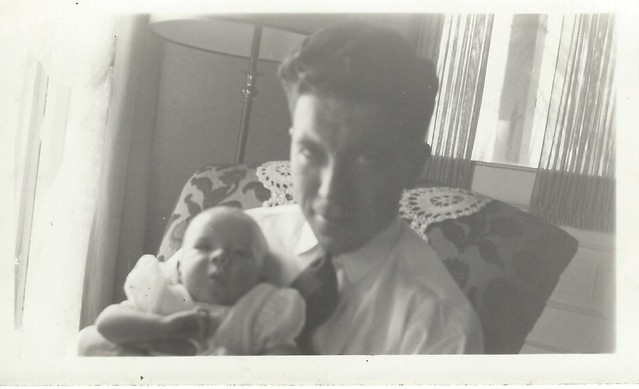
dad young 1943 with
Bernard Gourlay
Bernard Gourlay (grandfather) with James (my father)

Bernard Wilbur Gourlay
Early Life
Bernard Gourlay was born in 1921 in Amsterdam, NY, the son of a factory worker and homemaker. His mother had been previously married with children, and was 13 years older than his father[iii]. Bernard had a younger sister, but it doesn’t appear that any of his step-siblings lived with them. Bernard’s family moved to Auburn, NY sometime between 1930 and 1940, where his father found work as a foreman in a rug mill.

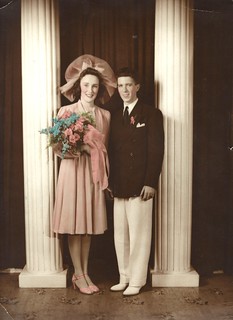
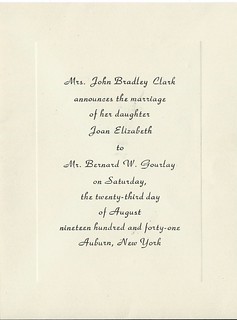
In school, Bernard was a boy scout, and a tennis player of some local reknown. After graduating in 1939, he joined his father as a laborer in a carpet factory where he might have remained if the winds of war had not already begun to blow.  In 1941 he married Joan Clark, a girl from his graduating class. She called him Gooneybird; he called her Crack Pot. They had a son, James. By all accounts they were very happy for the briefest of moments.

Joan and Bernard 1939
graduationgourlay wedding
photograndma bower wedding
announcement
 “Bernie” and Joan as Graduates, Wedding photo, Wedding invitation

World War II
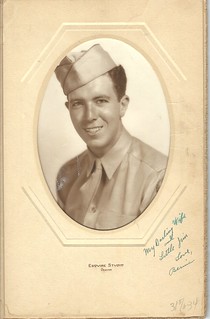
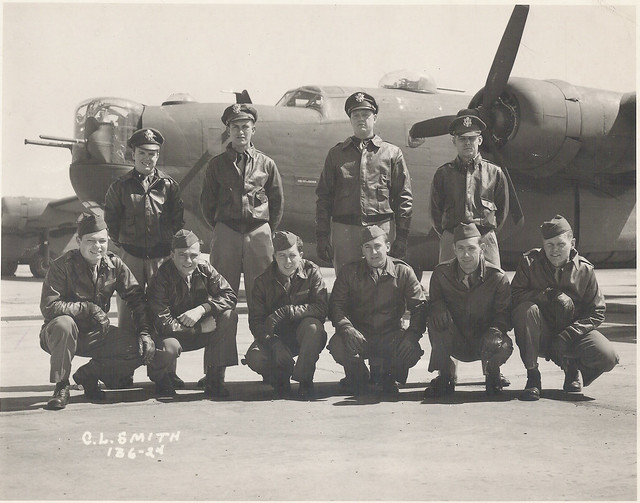
As the conflict intensified in 1943, Bernard was drafted into the Army. He moved with Joan and James to various training locations in Washington and elsewhere, before being sent overseas. Bernard, by then a SSgt in the Army Air Corps, was assigned to the 450th Bomber Group (Cottontails[iv]) operating out of Mandura, Italy. He was a ball turret gunner[v] on a B24 Liberator; an especially dangerous role in an occupation already fraught with risk. He had entered the war effort in a time and place where the life expectancy of bomber crews was tragically short. Men of the 450th would be relieved after flying their 50th mission. Set against the might of the German Luftwaffe and rain of AA flak, only a lucky few survived that long.

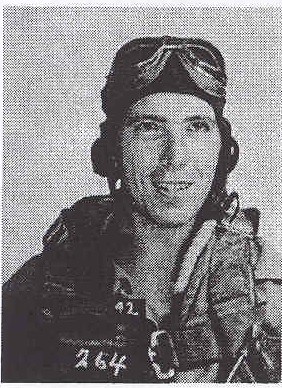
gourlay portrait with
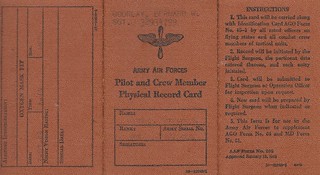
family messagegourlay crew member card
1
Gourlay during
WWII
Going to War Portrait, Air Crew member card, B-24 Liberator with Crew (Bernard at front left center)

After a flight of B-24s from the 450th successfully bombed Porto San Stefano, one of its retreating planes was shot down by anti-aircraft fire. In its death spiral, it sheared the tail section of another B-24, designated “The Margie” by her crew. The Margie followed her fellow ship down, crashing directly into the sea.  Its cabin crew never had time to don parachutes and escape, let alone the ball turret gunner, locked in position on the belly of the aircraft. Bernard and Joan’s dreams died over a lonely stretch of sea in May, 1944. James was 2 years old.


Epilogue
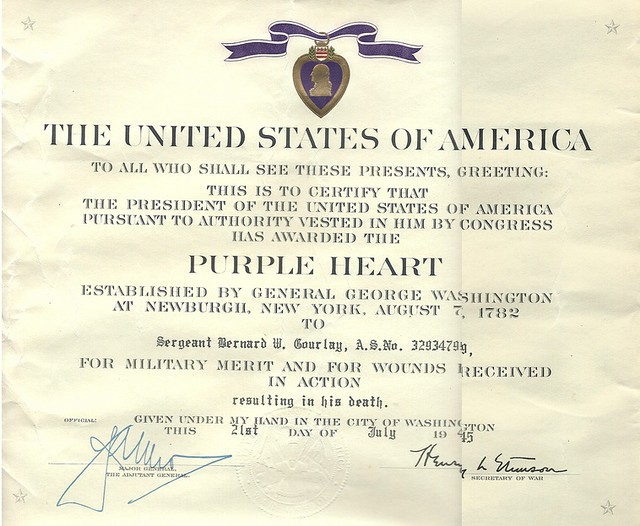
Officially, Bernard was listed as missing until many months later. For his sacrifice, he was awarded a Purple Heart, and the Air Medal for valor. Joan remarried some time afterward; another Army man and a hero in his own right. My father, James, told me about Bernard, when I was 12 years old. Someday I hope to see in person the Tablet of the Missing, in the American Cemetery in Florence, Italy, on which his name is inscribed.

aviator
The Aviator.

purple heart
Purple Heart


NOTES


[i] By which I mean the shallow, beginner level of genealogy, not that my gene pool is shallow.
[ii] I’m not ready to tackle the emotional mindfield of describing my parent’s lives, and I’ve already alluded to a lot of my own history in previous posts. So those two generations won’t be included.
[iii] She was 43 when she had Bernard, and at one time there was a rumor that he had been adopted.  Unfortunately, I don’t know of anyone living who can confirm this, and I have not been able to find any records to confirm or deny this. If he was adopted, then I may lose that entire side of my family’s history.
[iv] So named for the white tail sections on their B-24 Liberators. The Cottontails, as part of the 15th Air Force, were responsible for the raids and crippling of the Ploesti oil refinery complex, which dramatically impacted the German ability to wage war after mid 1944.
[v] The ball turret was gun turret located on the belly of the aircraft. Its gunners had to be lowered into place, and could not easily escape their turret in emergencies.  It was especially vulnerable to fighter attacks and ground fire. Ball turret gunners had among the lowest life expectancies of bomber crews.  

Monday, April 6, 2015

Incidental Coast

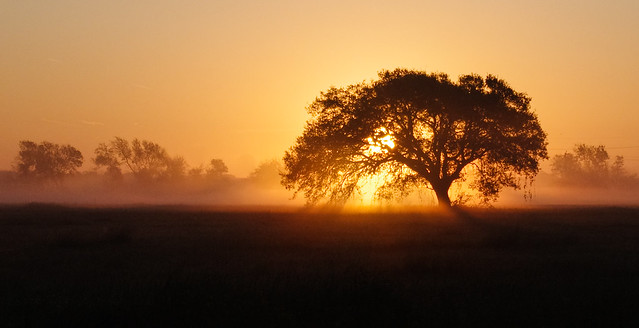
Coastal Prairie Sunrise

Like a lot of my hobbies these days (including this blog if that wasn't painfully clear), my hiking and photography time has been fairly limited. When I've gotten out and about , it's usually is a matter of leftover minutes or hours tacked on to trips with a more Adult Purpose(tm).  

At the end of March I had a water quality event down on the Gulf Coast, directly adjacent and including part of Brazoria National Wildlife Refuge. Given that it was a beautiful day, spring migration had just begun, and I was required to have my camera for the work event anyway, I indulged in a little incidental coastal photography.

Brazoria Colors
Colors of Brazoria NWR

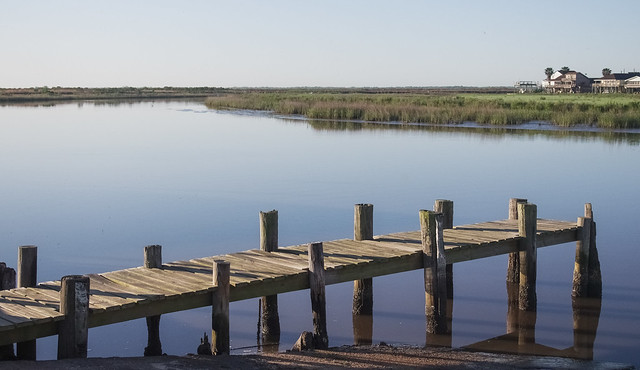
Marlin Marina
Repurposed Boat, Marlin Marina, Demi-John

The Texas Gulf Coast is an odd place. While there are some places like Galveston that are the epitome of tourist destinations, most of the upper Texas coast is a mishmash of impenetrable coastal wetlands, small run down towns, and vast petrochemical complexes.

Bottle in the Sand
Bottle in the Sand

Bastrop Bayou at Demi-John
Bastrop Bayou

Old BOat
This Way

 The clanging juxtaposition of vast stretches of flat open land and remnants of past and current oil production scattered across the landscape always give it sort of a post-apocalyptic feel to me. Add to it the fact that you can drive on most beaches here, and it just begs for exploration. Even with the small amount of time I had that day, I managed to jaunt about and get a couple pictures during my efforts.  There's no real theme, just a couple shots from the day. Sorry about all the birds, as usual.

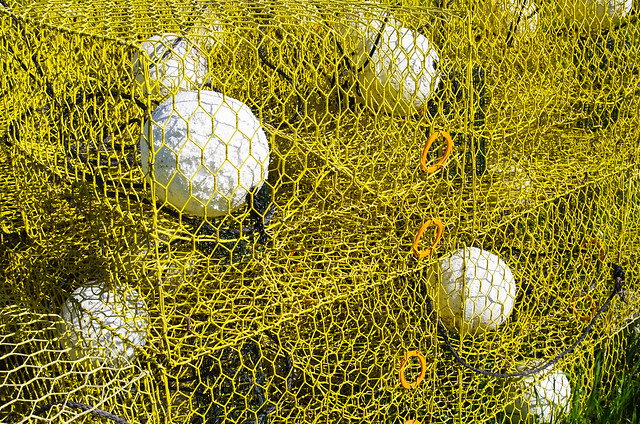
Traps
Traps

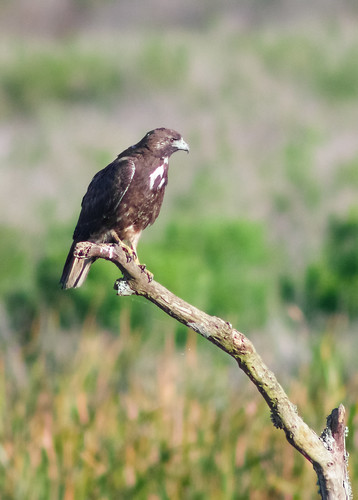
Mallard touch downWhite-tailed Hawk (juvenile)
Mallard coming in for landing; White-tailed Hawk (juvenile)

Bluebonnets
Bluebonnets

Indian Paintbrush
Indian Paintbrush

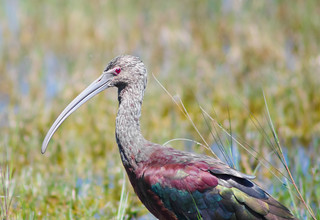
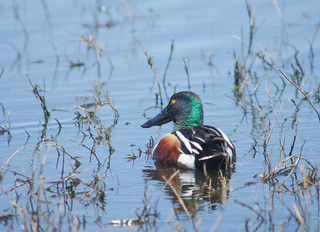
White=faced IbisNorthern Shoveler (drake)
White-faced Ibis, Northern Shoveler

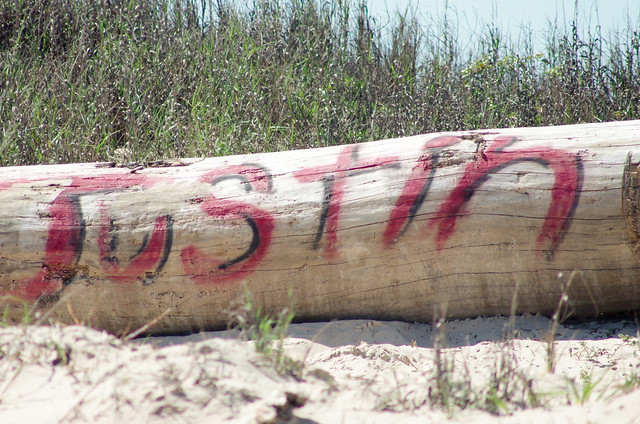
I didn't do it.
I didn't do it.